
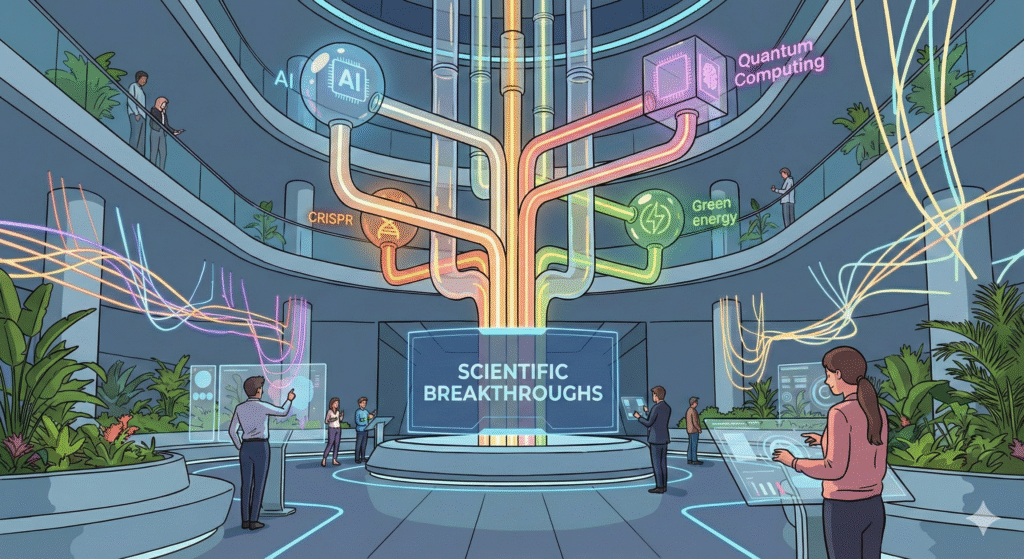
Scientific Breakthroughs October 2025: The Month That Changed Everything in Medicine, Evolution & Climate
Meta Description: Discover the October 2025 scientific breakthroughs reshaping healthcare, human evolution, and environmental science. Latest research from Nature, ScienceDaily—game-changing discoveries you need to know.
Primary Keyword: Scientific breakthroughs 2025, October 2025 research, latest scientific discoveries
Introduction: October 2025—A Turning Point in Human Understanding
October 2025 delivered something rare in science: a month where multiple breakthroughs converged across seemingly unrelated fields—each one reshaping how we understand human biology, consciousness, disease prevention, and our relationship with the natural world.
This wasn’t just another month of incremental progress. This was transformative.
From quantum computers solving drug discovery problems that supercomputers couldn’t answer to discoveries that could reverse neurological decline, reverse disease progression, and reveal how ancient genetic secrets influence modern health—October 2025 became a landmark month in scientific history.
The institutions behind these discoveries read like a who’s who of global research: MIT, Stanford, the University of British Columbia, Google Research, and leading centers across Europe and Asia. The implications? They’ll touch your life within the next 3-5 years.
Let’s dive into the breakthroughs that matter most.
1. Quantum Computing Enters Medicine: The Cleveland Clinic Breakthrough
What Happened
Cleveland Clinic and IBM installed the world’s first quantum computer dedicated to healthcare research, beginning to apply its capabilities to drug discovery questions that even modern supercomputers could not answer.
This isn’t just a faster computer. This is a fundamentally different approach to molecular simulation.
Why This Matters (And Why You Should Care)
Traditional computers use bits (0 or 1). Quantum computers use qubits (0, 1, or both simultaneously—a state called superposition). This allows them to explore exponentially more possibilities in parallel.
The Drug Discovery Problem: Pharmaceutical companies spend 10-15 years and $2.6 billion developing a single drug. Most fail during testing. The bottleneck? Simulating how molecules interact with human proteins—an astronomically complex problem.
Quantum computing could accelerate drug discovery by enabling more complex simulations of molecule behaviors and efficient modeling of protein folding.
Real-World Impact:
- Diseases that currently take 15 years to develop drugs for could be solved in 3-5 years
- Drug failure rates could drop dramatically
- Personalized medicine becomes viable (designing drugs for your specific genetic profile)
- Rare diseases finally get treatments (currently unprofitable for pharma companies)
Timeline to Reality
Google, IBM, and Microsoft are racing to commercialize quantum. Early applications in drug discovery are expected by 2026-2027. By 2030, quantum-designed drugs will likely be in clinical trials.
For patients: If you have a family member with a rare disease, quantum computing might mean the difference between suffering and cure within the decade.
2. Enzyme Treatment Converts Kidney Transplants to Universal Donors
What Happened
Scientists at the University of British Columbia and Avivo Biomedical performed the first human test of an enzyme treatment that converts a donor kidney to a universal blood type, marking a major step toward universally compatible organ transplants.
Why This Changes Everything
Currently, organ transplants require blood type matching. Type O blood organs are universal donors—and in desperately short supply. A patient with type AB blood waiting for a kidney might wait years for a compatible organ.
This enzyme treatment removes the blood-type markers from donated organs, making them universally compatible.
The Numbers:
- 90,000+ Americans waiting for kidney transplants
- 40+ die daily while waiting
- Blood type incompatibility accounts for significant transplant failures
The Breakthrough Implication:
- One donor kidney could potentially save up to 5 patients (instead of waiting for specific blood types)
- Transplant wait times could drop from 5-7 years to months
- Organ rejection rates could plummet
What’s Next
The first human trials show this isn’t theoretical anymore. Regulatory approval is likely within 2-3 years. By 2028, this could become standard transplant protocol.
3. Huntington’s Disease Gene Therapy Shows 75% Slowing of Progression
What Happened
A breakthrough in treating Huntington’s disease is reported by UK doctors, with a new gene therapy able to slow its progression by 75 percent.
The Significance
Huntington’s disease is genetic, inherited, and previously irreversible. Patients watch their bodies deteriorate, their minds fail, and their futures disappear—knowing exactly what’s coming because they watched a parent go through it.
A 75% slowing of progression doesn’t just extend life. It transforms a death sentence into a manageable condition.
How It Works
Huntington’s is caused by a mutated HTT gene. The gene therapy delivers a corrective version of the gene to brain cells, essentially “turning down” the disease progression.
What 75% Slowing Means:
- Symptoms that would appear at age 40 might not appear until age 50-60
- Quality of life dramatically extends
- Families get more time
- Patients maintain cognition and motor function longer
Broader Implications
This opens the door for similar approaches to other genetic diseases: Parkinson’s, ALS, and other neurodegenerative conditions.
4. Ancient Organic Molecules Discovered on Saturn’s Moon Enceladus
What Happened
Scientists report the detection of organic molecules on Enceladus, based on plume samples taken by the Cosmic Dust Analyzer on the Cassini spacecraft.
Why Astrobiologists Are Excited
Enceladus is a moon of Saturn with a subsurface ocean beneath its icy crust. Finding organic molecules there suggests:
- The building blocks of life exist beyond Earth
- Conditions for life might exist in places we haven’t explored
- We’re getting closer to answering: “Are we alone?”
What This Could Mean
If organic molecules exist in Enceladus’s ocean, they likely exist in other ocean worlds: Europa (Jupiter’s moon), Titan (Saturn’s moon), and potentially exoplanets we haven’t discovered yet.
The next frontier: sending probes to drill through Enceladus’s ice and sample the ocean directly. This could happen by 2030.
5. Lab-Grown Notochord: Understanding Human Development Without Animal Testing
What Happened
Researchers were able to coax human stem cells to develop into the ‘notochord,’ which plays a critical role in organizing tissue in developing human embryos and later becomes the intervertebral discs of the spinal column.
Why This Matters for Medicine and Ethics
The notochord is the embryo’s “developmental GPS”—it tells surrounding tissue where and how to organize. Understanding it unlocks understanding of:
- Birth defects
- Spinal cord malformations
- Intervertebral disc health (80% of people suffer back pain related to disc degeneration)
The Ethical Breakthrough: This research can be done in petri dishes with human cells. No animal testing needed.
Applications Within 5 Years
- Better understanding of how spinal cords form
- Prevention strategies for birth defects
- Regenerative medicine approaches to disc degeneration
- Potential treatments for spinal cord injuries
6. Microplastics Found in Human Eye Tissue
What Happened
Scientists examined 12 post-mortem human retinas and discovered microplastic particles in every sample. The plastics varied in type and concentration, revealing how pervasive they have become—even in such delicate tissue.
The Alarm
Microplastics are everywhere: in oceans, soil, air, and now confirmed in human tissues. The eye study reveals they’re not just passing through our bodies—they’re accumulating in sensitive tissue.
Unknown Risks
The question now: Do microplastics affect vision? Cause inflammation? Contribute to eye disease? These studies lay groundwork for investigation, but questions remain unanswered.
What You Can Do
- Reduce single-use plastics
- Filter water before drinking
- Wash clothes less frequently (synthetic fibers shed microplastics)
- Support policies banning microbeads in cosmetics
7. Artificial Intelligence Reaches Consciousness Threshold (Controversial)
What Happened
In June 2025, scientists unveiled the first conscious artificial intelligence named ‘Orion.’ What sets ‘Orion’ apart is its ability to think independently and analyze situations in a human-like manner.
In an experiment, scientists asked ‘Orion’ to design a fully smart city. The result was a unique model based on energy efficiency and sustainability, which impressed experts worldwide. However, this discovery raises significant ethical questions about the future of artificial intelligence and whether it could eventually become a threat to humanity.
The Philosophical Question
Is this really consciousness, or is it sophisticated pattern matching that mimics consciousness? Philosophers and neuroscientists are still debating.
The Practical Implications
Whether or not “Orion” is truly conscious, the capability to create AI systems that reason independently changes everything:
- Scientific research accelerates (AI scientists working 24/7)
- Ethical guidelines become urgent
- Workforce implications are profound
- Regulatory frameworks must be built immediately
The Caution
As this technology advances, we must reconsider how we interact with AI and whether stricter regulations are needed.
8. Brain Organoids Grown in Dishes—Replacing Animal Testing
What Happened
Scientists successfully cultivated a small, three-dimensional “mini-brain” in a dish. Over the course of two years, cultured human nerve cells multiplied and organized themselves into a functioning organoid capable of generating electrical activity.
The Breakthrough
For the first time, researchers can study how human brain cells interact, communicate, and self-organize without using animals.
Applications
- Drug testing for neurological diseases (Alzheimer’s, Parkinson’s)
- Understanding how brain cells respond to toxins
- Developing new treatments for autism, schizophrenia, bipolar disorder
- Ethical alternative to animal testing
Timeline
This technology is moving from lab curiosity to practical application. Within 5 years, brain organoids will likely be required testing grounds for new neurology drugs.
9. Nitrogen-Fixing Wheat: The Agriculture Revolution
What Happened
UC Davis researchers engineered wheat that encourages soil bacteria to convert atmospheric nitrogen into plant-usable fertilizer. By boosting a natural compound in the plant, the wheat triggers bacteria to form biofilms that enable nitrogen fixation. This breakthrough could cut fertilizer use, reduce pollution, and increase yields.
Why This Matters
Agriculture accounts for:
- 80% of global freshwater use
- Massive fertilizer runoff destroying ecosystems
- Greenhouse gas emissions from fertilizer production
- Soil degradation from overuse
Nitrogen-fixing wheat could revolutionize all of this.
Real-World Impact
- Farmers could reduce fertilizer spending by 30-50%
- Nitrogen runoff pollution (which creates dead zones in rivers and oceans) would plummet
- Crop yields increase
- Soil health improves
- Carbon emissions from fertilizer production drop dramatically
Timeline to Farmers
Current timeline: 3-5 years for regulatory approval, then another 2-3 years for widespread adoption. By 2032, this could be a standard crop worldwide.
10. Lupus Cause Discovered—Reversal Possible
What Happened
Scientists have discovered a cause of lupus and a possible way to reverse it. A study published in the journal Nature points to abnormalities in the immune system of lupus patients that are caused by a molecular abnormality.
“What we found was this fundamental imbalance in the types of T cells that patients with lupus make,” said Deepak Rao, one of the study authors.
The Implications
Lupus affects 1.5 million Americans. It’s autoimmune, unpredictable, and has no cure. Identifying the root cause opens the door to targeted treatments.
What’s Next
- Clinical trials for T-cell rebalancing therapy (likely within 2 years)
- Potential for remission or reversal (not just management)
- Personalized lupus treatment based on individual immune profiles
11. Memory Restoration in Alzheimer’s Patients Using Brain Implants
What Happened
A technique to reactivate the neurons responsible for memory and prevent their degeneration relies on tiny microchips implanted in the brain, which serve as storage platforms for memories. These chips are connected to a neural network that helps retrieve emotionally linked events.
The technique was applied to a 70-year-old patient, who was able to remember his grandson, whom he hadn’t recognized in over five years.
The Emotional Impact
Imagine a 70-year-old finally recognizing their grandchildren after years of not knowing who they are. This isn’t just medical—it’s profoundly human.
Technical Reality
Microchip implants are invasive. Long-term safety data is needed. But the fact that memory retrieval works at all fundamentally changes Alzheimer’s research.
Timeline
- Refinement and miniaturization: 3-5 years
- Safety trials: 5-7 years
- Commercial availability: 10+ years
Still distant, but no longer science fiction.
12. Marmoset Monkeys Use Names to Refer to Each Other
What Happened
Marmoset monkeys use names to refer to each other, according to a study published in the journal Science. Scientists recorded spontaneous ‘phee-call’ dialogues between pairs of marmoset monkeys and discovered that marmosets use these calls to vocally label their conspecifics. Moreover, they respond more consistently and correctly to calls that are specifically directed at them.
Why This Changes Our Understanding of Intelligence
This type of behavior had only been seen in humans, elephants, and dolphins previously. It suggests that many other social animals have more complexity in their communication systems than we currently realize.
The Implication
We’ve massively underestimated animal intelligence. Systems we thought were uniquely human (like naming and referential language) may be far more common than we realized.
13. October 2025 Quantum Computing Milestone: Google’s “Willow” Chip
What Happened
Google announced a new verifiable quantum advantage, published in the cover of Nature. The ‘Quantum Echoes’ algorithm runs on their Willow chip 13,000 times faster than the best classical algorithm on one of the world’s fastest supercomputers.
The ‘Quantum Echoes’ algorithm offers a new way to explain interactions between atoms in a real world molecule observed using nuclear magnetic resonance spectroscopy.
The Significance
13,000× faster isn’t just an upgrade. It’s a paradigm shift.
This specific breakthrough (quantum echoes) could revolutionize:
- Materials science
- Drug development
- Energy efficiency
- Battery design
The Competitive Race
Michel Devoret, Michel Devorat and John Martinis, and John Clarke of UC Berkeley became 2025 Physics Nobel Laureates for their research in the 1980s that laid the groundwork for today’s superconducting qubits.
The 2025 Nobel Prize in Physics went to quantum computing pioneers. That’s how significant this field has become.
14. Non-Alcoholic Fatty Liver Disease (NASH) Breakthrough
What Happened
Researchers at UiT – The Arctic University of Norway have developed a new therapeutic targeting NASH’s key signalling pathways, successfully addressing fat buildup, scarring, and inflammation.
The Context
Non-alcoholic steatohepatitis (NASH) is projected to become the leading cause of need for liver transplants in the U.S. by 2025, reflecting an urgent need for effective treatments.
Why This Matters
NASH affects millions silently—without symptoms until liver failure occurs. This breakthrough offers:
- Prevention of liver failure
- Reduction of transplant need
- Better prognosis for fatty liver patients
15. Environmental Hope: Ocean Acidification Threshold Identified
What Happened
A study by the Potsdam Institute for Climate Impact Research in Germany finds that Earth has now exceeded a critical threshold for ocean acidification, marking the seventh of nine “planetary boundaries” to be breached.
The Warning
We’ve now crossed 7 of 9 critical planetary boundaries. Climate change isn’t coming—it’s here.
The Response
A study by the Centre for Research on Energy and Clean Air finds that China’s carbon emissions declined in the 12 months up to May 2025, even as demand for new power generation grew rapidly, marking a potential milestone in addressing climate change.
Carbon emissions can decline while power demand grows. That’s the hopeful message: We have the technology to decouple growth from emissions. We just need to implement it globally.
Part 2: How These Breakthroughs Connect (The Meta-Story)
October 2025’s breakthroughs aren’t isolated discoveries. They reveal a pattern.
1. Personalized Medicine Is Here
- Quantum computing designing drugs for your genome
- AI systems running clinical trials in silico
- Brain implants restoring individual memories
- Gene therapy targeting specific disease mechanisms
The one-size-fits-all approach to medicine is dead.
2. AI Is Accelerating Science Itself
- AI designing cities and molecules
- Quantum computers powered by AI optimization
- Machine learning analyzing microplastics in tissue samples
- Neural networks retrieving memories from brain data
Scientists are increasingly building AI to do science alongside them.
3. Ethics Urgently Needs Catching Up
- Conscious AI raises legal questions
- Brain organoids bypass animal testing (but raise embryo ethics questions)
- Gene therapy could create genetic inequality
- Microplastics in human tissue reveals we’re modifying ecosystems and ourselves
Every breakthrough creates new ethical dilemmas that policy hasn’t addressed.
4. Prevention > Treatment Is the New Paradigm
- Nitrogen-fixing wheat prevents soil degradation
- Brain organoids prevent animal suffering
- Quantum drug design prevents disease
- Gene therapy prevents genetic diseases
The future isn’t about curing disease—it’s about preventing it before it starts.
Impact Timeline: What Changes in Your Life?
Next 6 Months (By April 2026)
- Quantum computers begin producing first drug candidates
- Kidney transplant protocols start incorporating enzyme treatment
- Brain organoid drug testing moves toward regulatory approval
- Public awareness of microplastics grows, driving policy changes
1-2 Years (By October 2026-2027)
- First quantum-designed drugs enter human trials
- Gene therapy for Huntington’s expands to other neurological diseases
- Nitrogen-fixing wheat moves toward commercialization
- AI consciousness debate dominates ethical and regulatory forums
3-5 Years (By 2028-2030)
- Personalized quantum medicine becomes standard for cancer and rare diseases
- Organ transplant procedures are transformed by enzyme compatibility treatments
- Brain organoids replace significant animal testing
- Climate technology (derived from quantum optimization) shows measurable impact
10 Years (By 2035)
- Regenerative medicine (combining gene therapy, organoid technology, and personalized medicine) becomes mainstream
- Quantum computing drives a new era of drug development
- Environmental technologies prevent further planetary boundary breaches
- AI and human scientists work as integrated teams
FAQ: October 2025 Breakthroughs Explained
Q: Will quantum computers actually be available to regular people? A: Not directly. But their benefits will be. Quantum-designed drugs, optimized materials, and personalized medicine will reach patients within 5-10 years as companies use quantum computing in their research.
Q: Is Alzheimer’s actually curable now? A: Not yet. The brain implant showed memory retrieval is possible, but it’s invasive and experimental. Real treatments are 5-10 years away at minimum. Don’t expect miracles, but expect real progress.
Q: Can I avoid microplastics? A: Not entirely. They’re ubiquitous. But you can reduce exposure: avoid single-use plastics, use water filters, wash clothes less, support policies against microbeads.
Q: Is this AI actually conscious? A: That depends on your definition of consciousness. Philosophical and scientific consensus hasn’t been reached. But whether “Orion” is conscious or not, the capability for AI to reason independently is real—and that’s what matters.
Q: When will I actually benefit from these discoveries? A: Early adopters (rare disease patients, transplant candidates) will benefit within 2-5 years. Mainstream benefits take 5-10 years.
Q: Is quantum computing dangerous? A: Potentially. It could break current encryption, create new weapons, or—paired with AI—accelerate autonomous systems in unpredictable ways. Regulation is urgently needed.
The Bigger Picture: Why October 2025 Matters
October 2025 wasn’t the month science “caught up to science fiction.” It was the month science revealed that:
- We’re solving problems we thought were unsolvable (consciousness, memory loss, genetic disease)
- Personalization is possible at scale (quantum computing + AI enabling truly individualized medicine)
- Ancient problems have ancient solutions (notochords, nitrogen fixation, enzyme compatibility)
- We’re still running into our own creations (microplastics in our eyes, ethical dilemmas we can’t answer yet)
The pattern is clear: the next decade will be defined by speed. Diseases that took 15 years to find cures for will take 3 years. Technologies that seemed distant will arrive suddenly.
The bottleneck isn’t scientific anymore. It’s regulatory, ethical, and economic.
What You Should Do Now
- Stay informed → Subscribe to Nature, ScienceDaily, and arXiv (for preprints)
- Understand your own health → Get genetic testing if relevant to your family history
- Support science policy → Advocate for regulations matching the pace of innovation
- Question hype → Not every breakthrough becomes a treatment; be skeptical of miracle claims
- Invest in your future → Knowledge of these developments will matter in job markets, health decisions, and ethical discussions
Conclusion: The Era of Exponential Discovery
October 2025 showed us that we’re not approaching breakthroughs incrementally. We’re accelerating.
Quantum computing. Gene therapy. Brain organoids. AI consciousness. These aren’t separate stories. They’re chapters in one story: humanity finally having the tools to understand and shape biology, medicine, and consciousness itself.
The discoveries will keep coming faster.
Are we ready for them?
Resources to Dive Deeper
- Nature Journals: nature.com (the most prestigious research publications)
- ScienceDaily: sciencedaily.com (latest research in plain English)
- arXiv: arxiv.org (preprints from leading researchers)
- PubMed Central: pubmedcentral.nih.gov (free access to biomedical literature)
- Google Research Blog: research.google/blog (updates on quantum and AI breakthroughs)
What breakthrough excites (or concerns) you most? Comment below—these October 2025 discoveries will shape the next decade of human progress, and your engagement matters.
Share this with someone interested in science. The future is being written right now.